










Now Available: Electricity for the Mind: The Anomalist 14
March 30, 2010
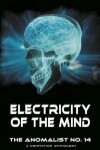 It took us a year and a half to get this one out, but we think you’ll find it was worth the wait. Ian Simmons, who edited the last issue of Fortean Studies, was our guest editor this time around and he did a fabulous job. He calls this issue, our 14th, Electricity of the Mind – instant CPR for the head. Inside you’ll find this tantalizing line-up of articles: Theo Paijmans mines the rich seam of digital newspaper archives to look at anomalies in a whole new way. Ulrich Magin ventures into a previously neglected corner of Earth Mysteries, taking us on a tour of out-of-place volcanoes across Europe. Dwight Whalen explores a forgotten tale of bizarre visions that brought vivid omens of World War I to the skies of Pennsylvania in 1914. Cameron Blount examines the implications of archaeological relics of Peru’s mysterious Moche culture and what they might tell us about the neighboring Nazca culture. Mike Jay discusses Samuel Taylor Coleridge’s lasting and deep interest in the supernatural. Bryan Williams, Annalisa Ventola, and Mike Wilson provide a basic primer for exploring temperature and magnetic fields in cases of haunting. Patrick Gyger uses the “Black Books” of Fribourg to understand the mindset behind witch trials in the late 15th Century. Aeolus Kephas looks at the similarities between two of the 20th Century’s most popular and charismatic “literary shamen”: Carlos Castaneda and Whitley Strieber. John Caddy seeks a common root behind the various biological energies not known to science on which many esoteric knowledge systems rely. Chris Payne takes a new mathematical approach in trying to determine whether there are still Thylacines out there. Mark Pilkington takes a look back into the prehistory of crop art and reveals a thought-provoking precursor from the movies. Gary Lachman shares his previously unpublished notes from his book Politics and the Occult. Richard Wiseman, Professor of the Public Understanding of Psychology, recounts his discovery of the first ever film of a magic trick. And last but not least, Tim Cridland, whose stage name is Zamora the Torture King, takes a long, hard look at the career of leading skeptic James Randi. Altogether this issue is sure to spark your imagination!
The Cryptoterrestrials is now available
March 9, 2010
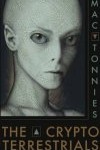 This is a bittersweet moment. Mac Tonnies is no longer with us, but his long-awaited book finally is. The Cryptoterrestrials has now been published. It’s a short book that’s packed full of ideas. What’s important is not that they all be right, but that they stretch our minds to think beyond the idea of “aliens” as “extraterrestrials.” That’s why the book is subtitled “A meditation on indigenous humanoids and the aliens among us.” Mac had asked Nick Redfern and Greg Bishop to contribute to the book; Nick wrote the Foreword before Mac’s death, and Greg wrote the Afterword after the news of his passing. In addition, John Shirley, who has long been a supporter of Mac’s work, was kind enough to supply us with a blurb that says, in part, “The Cryptoterrestrials is the most refreshing speculation on the paranormal I’ve seen in ages…Mac Tonnies’ final Fortean landmark is the Book of the Damned for the 21st century.” Finally, Nadia Sobin contributed the striking cover art and Mike Clelland did the wonderful illustrations that begin each chapter. In Mac’s memory, thank you, all.
An Explicit and Very Powerful Book
February 15, 2010
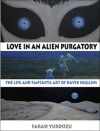 On her website, Kay Wilson, the author of The Alien Jigsaw, not only reviews our book, Love In An Alien Purgatory: The Life And Fantastic Art of David Huggins by Farah Yurdozu, but comments on David Huggins’ alien abduction experiences as well. Wilson, who is an abductee herself, says that it is David, “the artist-abductee, who brings the nitty-gritty of abduction to life in the pages of this fascinating, and at times, disturbing book.” The Hybrid Beings play a major role in an abductee’s life, notes Wilson, and “David’s case is no different in this respect. What is different about this book however, is the manner in which this interaction is relayed to the reader. It is explicit and it is very powerful… It was a bold decision of the author, as well as Anomalist Books, not to censor this information and I commend their decision. The images in this book demonstrate what a prominent occurrence of abduction is really like.” Wilson ends her lengthy review with these words: “Love In An Alien Purgatory is a beautifully illustrated story of the life of an alien abductee, presented by a leading authority of alien abduction and the paranormal. It is a book every serious student of alien abduction research should have in their library.”
"A Mind Bender in the First Degree"
February 12, 2010
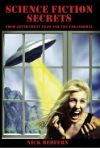 “I have to start by saying how immensely I enjoyed this book,” so begins Micah. A. Hanks’ review in The Gralien Report of Nick Redfern’s Science Fiction Secrets: From Government Files and the Paranormal. Writes Hanks: “From strange FBI tales involving the apparent paranoia of Sci-Fi writers like Phillip K. Dick, to weird parallels he draws between the terrorist attacks of 9-11 and television programs that predicted the disaster before it happened, this book is a mind bender in the first degree…The old adage ‘truth is stranger than fiction’ comes to mind often when reading this gem, and if you ever doubted it, this will be the manuscript that will finally change that perception. Read it, enjoy it, and be prepared to never see the world around you quite the same way you once did.” Sounds like Hanks liked the book, don’t you think? Considerably more reserved about the book, as expected, is Peter Rogerson at Magonia: “It is…a moot point whether any of the bizarre tales one encounters here and elsewhere are deliberately circulated by governments to baffle foreign intelligence services and to protect real secrets and scandals with a bodyguard of cranks, or as black propaganda…There is no doubt that Nick Redfern gives us an exciting read, but it has to be said that if there is a bodyguard of cranks, he doesn’t half help it along… A jolly good read but keep a full salt-cellar handy.” Of course, Rogerson fails to mention that Redfern actually points out that many of the stories do stretch credibility. Redfern, in fact, is not afraid to detail the failures, the flaws, and the character eccentricities in the stories he recounts; in no way does he suggest that all the things in the book are valid. And just what these stories represent is not a moot point.
An Interesting and Puzzling Tale
February 11, 2010
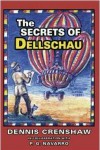 The Secrets of Dellschau: The Sonora Aero Club & the Airships of the 1800s, A True Story by Dennis Crenshaw with P.G. Navarro continues to get good press. Phil Barker reviewed the book for Fortean Times and said: “…a book packed with interest, coming at a junction of several fascinating areas: outsider art, early flight, coded texts, alternative technologies and even a touch of trippy steampunk. It includes a brief resume of early flight in America and elsewhere (mostly balloon-based), [and] the UFO-like “Great Airship Mystery” of 1896-7…” His final verdict on the book? An “interesting and puzzling tale of America’s early flyboys.” Elsewhere, in the Valley Advocate, James Heflin has penned an ode to the surprises one can pick up at yard sales, estate sales, and landfills (which is just how Dellschau’s now valuable notebooks were discovered) in his feature story on the book. Writes Heflin: “Crenshaw’s book on Dellschau is an authoritative source…a fascinating voyage of exploration that opened intriguing doors of possibility.”
"An Absorbing and Authoritative Read"
February 9, 2010
 Catching up on some recent reviews from some scholarly sources…Keith Petrie, from the University of Auckland, has reviewed Outbreak! The Encyclopedia of Extraordinary Social Behavior by Hilary Evans and Robert Bartholomew for the Journal of Psychosomatic Research. Writes Petrie: “This book presents more examples of mass psychogenic illness and panics than you could shake a faith healer at. There are many example of the usual outbreaks at schools and factories but many other exotic ones involving slashers, phantoms, vampires, and various toxic substances. Even Bin Laden makes a cameo appearance. The book is organized alphabetically from outbreaks beginning with ‘A’ such as the Amou Barking Mania through to beyond the Zimbabwe Zombie School. In between are fascinating examples of strange collective behavior.” He goes on to note that the book has been “meticulously compiled” and ends by saying that “Outbreak! is a valuable source of material…an absorbing and authoritative read and an extremely valuable reference for anyone interested in the field of psychosomatic medicine.”
Ingenious Research Projects, Well Written Book
February 8, 2010
 “At last, someone doing scientific studies on astrology and publishing their results,” begins Robert Marks’ review of Astrology Off the Beaten Track: A Scientific Study of Planets and Personality by Dr. Suzel Fuzeau-Braesch, who died in 2008. Marks states that “Her research projects were ingenious. She did studies on twins and world events. She even studied dogs and cows!” He ends his detailed, largely complimentary review with these words: “The book…is well written with simple, easy to read language…Of course, the work has to be thoroughly examined and we have to see if it can be replicated. Of so, then it provides support for the earlier Gauquelin work, and that would indicate that there might be something to astrology after all.” Marks’ review appears in the Winter 2009 issue of the Journal of Scientific Exploration.
"Wonderfully Thought-Provoking"
December 17, 2009
The reviews of The Secrets of Dellschau: The Sonora Aero Club and the Airships of the 1800s, A True Story by Dennis Crenshaw in collaboration with P. G. Navarro are beginning to appear. “We love this book because it tells an utterly unique story which may well be related to the UFO mystery,” writes Jim Mosely in Saucer Smear. “Or, it may not.” What’s the book about? In a review of the book in Magonia Peter Rogerson writes: “When he died at the great age of 92 in 1923, Texas butcher Charles A. Dellschau left behind a secret and a mystery. These were a series of notebooks, filled with paintings of fantastic flying machines, which only came to light when his descendants had a clearout. By a process of serendipity they came to the attention of graphic designer and ufologist Peter Navarro. By decoding and translating writings in and around the pictures, Narvarro pieced together a tale of Dellschau’s involvemnt in a secret society of inventors living in gold-rush California. He created a vivid cast of over 60 characters, and a range of Heath Robinsonish flying machines, the Aeros…They were the work of this secret group, The Sonora Aero Club, and its even more shadowy backer the NYMZA.” Were these craft connected somehow to the well-known UFO flap of 1896-1897? Magonia ends its review with these words: “Whether the audience is ufologist or art appreciator, this broken old man is leading us back into the realms of pure childhood imagination.” Moseley, near the end of his review, says straight-out: “This is a wonderfully thought-provoking book…” And he kindly commends Anomalist Books “for their fortitude in publishing books of this kind.”
"Wildly Entertaining, Absurdly Ambitious, and Astutely Critical"
December 14, 2009
Outbreak! The Encyclopedia of Extraordinary Social Behavior continues to generate press, including a column entitled “An outbreak of confusion: Mass hysteria, outlandish obsessions, bizarre sects: What lies at the heart of extraordinary social behaviour?” in The Guardian (UK) in August and a mention in a story called “Oh, Maya! Is 2012 the end? Film boosts doomsday frenzy” in USA Today in November. But it’s the reviews that concern us here and they have been uniformly positive. Inconvenient History calls the book “a wildly entertaining, absurdly ambitious, astutely critical, deceivingly academic and nearly definitive study of the myriad crazes, manias, panics, scares, fads, fashions and other sundry sociogenic phenomena that have made history while eluding historians.” This “Cthulhu-sized tome,” writes Nick Redfern in UFO Mystic, is not just “scholarly; but it is also highly informative, insightful, illuminating and witty… A fantastic read.” And in Cryptomundo, Loren Coleman, though not particularly pleased with the book’s handling of some subjects (“I find their black and white skeptical approach to a few of the encyclopedia’s events as being wholly too psychological-based, without any appreciation for the possible underlying factual reality to be found in some of these encounters”), nevertheless concludes that “the book is a masterpiece.” The International Cognition and Culture Institute blog found the book to be “quite an impressive endeavour that can be used for scholarly purposes (it is well referenced) and for fun (because people do weird things sometimes).” And finally, FOAFtale News, the newsletter of the International Society for Contemporary Legend Research, notes that “It is a real encyclopedia, containing some 340 articles of very variable length. The scope and diversity of the bibliography are remarkable; it includes numerous references from other languages than English. The large choice of nineteenth century French studies, mostly medical, of visions and apparitions is especially notable. Original sources are often referred to, and the quotations of Renaissance or seventeenth century books are numerous. This does not exclude modern references as will be shown in the example from Iraq…Exceptional by its scope and the diversity of its sources, this Encyclopedia is an essential work instrument for those interested in the surprising extent of non-standard collective behavior.”
Now Available: Swamp Gas Times
December 7, 2009
 We have just reprinted Patrick Huyghe’s Swamp Gas Times: My Two Decades on the UFO Beat. It’s the same as the original Paraview Press version but with a new cover. What we didn’t have then that we have now is Colin Bennett’s sparkling review of the book that eventually appeared online at Phenomena Magazine, which, sadly, is no longer being published. Take it away, Colin: “H.G. Wells once wrote An Experiment in Autobiography, and this title is a good description of Swamp Gas Times by Patrick Huyghe. There are very few books about UFOs that put the phenomenon in a setting of the character and atmosphere of a workaday journalistic world…[Huyghe’s] vision raises the sheer thrill of our dawning realization that we are indeed living within domains of high strangeness…What makes this remarkable book special is that it relates all these matters to American journalism as it evolved over two decades. Both journalism and the UFO inhabit unstable worlds; magazines, newspapers and staff are shown as being in an almost constant state of change. Editors, private financiers, policies, all can change within a matter of months… Thus his UFO reporting is against a professional background of varying levels of ever-changing technology, the whims of rich proprietors, and a rapidly changing print and media culture, changing again in turn as regards content and style, taste, fashion, and evolving social history. We see in Swamp Gas Times the UFO as a live cryptozoological animal, grazing on information flow as it moves through many different dimensions and interpretations of media, opinion, and changing forms of fashionable taste and expression… These stories are of a world full of hairline cracks and fissures, a world constantly crumbling at the edges of the discursive investigational eye like an M.C. Escher drawing of possible impossibilities… In the face of such things, [Huyghe] manages to combine a vigorous analytic logic with a brave ability to face the utterly absurd elements in many of the experiences he describes… Here is great insight, as well as the irresistible thrill of UFOlogy…”