










Now Available: FORBIDDEN SCIENCE 6: Scattered Castles, 2010-2019
January 18, 2025
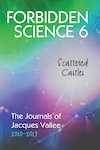 The penultimate volume of the journals of Jacques Vallee is now available from Anomalist Books. FORBIDDEN SCIENCE 6:
Scattered Castles, The Journals of Jacques Vallee 2010-2019 is the diary of an insider to the Pentagon’s once secret UFO investigation program. In these pages he comes to realize that the highly classified project he had joined will never be able to solve the many-dimensional mystery it investigates. Also revealed is his professional fascination for new business ventures that opens opportunities to draw new insights from biology and information physics. Vallee uses the literary skills of a mature diarist to introduce us to this colorful world of twenty-first century research. When the path to new solutions takes an unexpected turn, his psychic explorations enter a new domain, rich in emotional presences and esoteric insight.
The penultimate volume of the journals of Jacques Vallee is now available from Anomalist Books. FORBIDDEN SCIENCE 6:
Scattered Castles, The Journals of Jacques Vallee 2010-2019 is the diary of an insider to the Pentagon’s once secret UFO investigation program. In these pages he comes to realize that the highly classified project he had joined will never be able to solve the many-dimensional mystery it investigates. Also revealed is his professional fascination for new business ventures that opens opportunities to draw new insights from biology and information physics. Vallee uses the literary skills of a mature diarist to introduce us to this colorful world of twenty-first century research. When the path to new solutions takes an unexpected turn, his psychic explorations enter a new domain, rich in emotional presences and esoteric insight.
“A Splendid Biography”
June 28, 2024
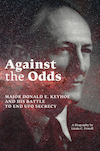 Against the Odds: Major Donald E. Keyhoe and His Battle to End UFO Secrecy by Linda Powell is our first biography and reviewers are over the moon about it. Christine Scott, on UFO Talker, called it “a landmark bio of Donald Keyhoe.” Jeffrey Mishlove of New Thinking Allowed said it’s “…the most well-researched book in the UFO field that I’ve ever seen…a must read book.” Author Leslie Kean called it “an inspiring work.” Nigel Watson, in Magonia, writes “Powell does an expert job of showing us the major characters and factors that constituted that influential period of UFO politics…” But it’s Jerry Clark, who in Fortean Times, best sums up this extraordinary work: “A towering figure in his time… Keyhoe is now the subject of Linda Powell’s solid, deeply researched biography…Against the Odds can be read as an object lesson in the dangers of public identification with a heretical opinion…Powell focuses on the societal, political, and personal side of the disputes that rages, sometimes within ufology itself, over matters both profound and petty. Though I am well versed in the history of the UFO wars, hardly a page of Against the Odds fails to inform me of something I didn’t know…One closes Powell’s splendid biography, which is sympathetic but hardly hagiographic, with the impression of an ordinary man who placed himself in extraordinary circumstances. Decades later, as physicists, journalists, historians, academics, pilots, and politicians—precisely the figures whom Keyhoe attempted with limited success to recruit into the ranks—descend on a subject barreling toward respectability, one wishes he were here to see what he started.”
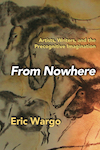 Where do new ideas come from? In his new book, From Nowhere: Artists, Writers, and the Precognitive Imagination, Eric Wargo argues that they come from the future, He supports that jaw-dropping hypothesis with numerous examples of artists and writers whose works revealed their own future. “Long story short,” writes Wargo in a recent post on Medium, “I think we all receive oblique and foggy signals from our future self when we are creating…” From Ice Age cave paintings to the novels of Virginia Woolf and Philip K. Dick, the films of Werner Herzog and David Lynch, and even the songs of The Beatles, Wargo makes a case for the inherently time-defying nature of inspiration. Wargo, the author of the acclaimed Time Loops, may well have cracked the key to the creative imagination.
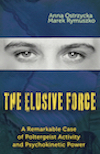 Those who are knowledgable about the poltergeist phenomenon have nothing but praise for The Elusive Force: A Remarkable Case of Poltergeist Activity and Psychokinetic Power by Anna Ostrzycka and Marek Rymuszko, and translated by Joel Stern. John Kruth, in his review in the Journal of Parapsychology, says “The case of Joasia Gajewska is one of the most phenomenal reports of long-lasting poltergeist activity that has ever been published.” Rosemarie Pilkington, in her review in the Journal of Scientific Exploration, explains why: “This case is one of the most important I have seen in a long time. It is one of the best-documented and well-investigated examples of Recurrent Spontaneous Psychokinesis (RSPK), also known popularly as “poltergeist” activity that has emerged to date…Joasia’s case is so rich because not only did she unleash such extremely powerful forces, but also such a variety of phenomena, too numerous to mention here, from spontaneous water appearing on walls to unexplained fires and shattering light bulbs whose filaments glowed long afterwards, to flying objects making right turns in mid-air…What makes Joasia’s case even more important is that Dr. Gadula did what, unfortunately, few researchers have done in other countries: He brought in other physicians, scientists, and researchers for a multi-disciplined study of the teenager…” Even those not so familialr with the subject, like David Trawinski of the Polish American Journal, had to admit the book was “thought-provoking.” We think you will, too.
Now Available: Against The Odds: Major Donald E. Keyhoe and His Battle to End UFO Secrecy
December 1, 2023
ONE MAN………the USAF….and UFOs. Who is that man? His name is Donald E. Keyhoe. And he is the subject of our first biography: Against The Odds: Major Donald E. Keyhoe and His Battle to End UFO Secrecy, by Linda Powell. You may be wondering: who is Donald Keyhoe and why is he so important? Keyhoe is largely responsible for the twin pillars of current UFO belief: that UFOs represent extraterrestrial technology and that the government is hiding this truth from us. If you have been following the news recently, you’ll know that the government, despite denials, has continued its lack of transparency with regard to UFOs. Leslie Kean, who has spent 23 years herself advocating for government transparency on the subject, says about the book: “Against the Odds is a fascinating, in-depth biography about an extraordinary human being and courageous pioneer who could not be deterred. An inspiring work.” This work takes its rightful place next to the acclaimed biographies of J. Allen Hynek and James McDonald, the other two towering figures of the golden years of UFOlogy.
“The Ultimate Litmus Test for Cryptozoologists”
December 1, 2023
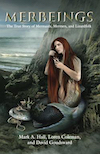 We wholeheartedly agree with John Rimmer, who in a review in Magonia entitled “A Rather Fishy Business,” calls Merbeings: The True Story of Mermaids, Mermen, and Lizardfolk by Mark A. Hall, Loren Coleman, and David Goudsward, “a very strange book.” Justin Mullis, in AIPT Comics, explains why: “Undoubtedly among the boldest of cryptozoology’s speculative creature creators was the late Mark A. Hall (1946-2016), whose talent for cryptid conjecture is on full display in his posthumously published Merbeings…[The book] represents the culmination of Hall’s lifelong interest in the possibility of amphibious primates…Hall offers readers the cryptozoologist’s equivalent of Pascal’s Wager: believe in monsters and lose nothing if they turn out to not exist, OR doubt their existence and end up looking foolish when physical evidence for them eventually turns up…Observations such as these—supported by copious endnotes and a healthy bibliography of primary and secondary scholarly sources—makes Merbeings a worthwhile addition to any folklorist’s library, irrespective of if you agree with Hall’s wilder contentions about a supposed biological reality behind the mermaid myth.. but as an exercise in speculative creature-building, I’d propose that the mermaid—more than the Sasquatch, Nessie, or even Mothman—embodies the ultimate litmus test for cryptozoologists.”
“An Astonishing Book”
December 1, 2023
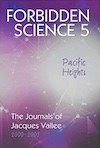 The reviews are in for Forbidden Science 5: Pacific Heights, The Journals of Jacques Vallee 2000-2009 and they are, as expected, glowing. Clive Prince, reviewing the book for Magonia, writes that Jacques Vallee has “a fine scientific and creative intellect, who manages to adroitly straddle the scientific, academic and fringe. All of which makes his journals invaluable documents for UFO researchers and enthusiasts…Forbidden Science really brings home the bewildering and frustrating complexity of the UFO enigma…[But] It’s not all UFOs and Aliens. Vallée keeps up his parapsychological interests, such as in remote viewing—including a project to track down Osama bin Laden—and taking a close interest in experimental evidence for precognition…All in all, Forbidden Science is crucial reading for anyone with an interest in the UFO phenomenon…” Bill Chalker of The Oz Files agrees: “There is much to fascinate and intrigue, and even frustrate the reader, as the journal describes the complexities of Vallee’s interactions with the phenomenon, the folklore and the impact of it, as well as the many twists and turns of the various participations and descriptions of the more secretive approaches to researching and investigating it…Thank you Jacques Vallee for your courage and persistence…I recommend Forbidden Science 5…” And lastly, Jeffrey Kripal, writing in the Journal of Scientific Exploration, says: “This is an astonishing book, and on a number of levels… Allow me to explain why this book moved me so, why I think it is so important to what is going on today in the American public media and the U.S. political, military, and intelligence communities, and why you should, yes, really read these pages…like right now.”
Now Available: The Elusive Force
December 1, 2023
We have long been fascinated by poltergeist cases, but we don’t recall any cases where the young girl at the center of the outbreak later went on to wield her psychokinetic powers consciously—and do so in the presence of doctors and scientists studying her abilities. Such is the case of Joasia Gajewski, whose story is told by a pair of Polish journalists, Anna Ostrzycka and Marek Rymuszko. The book, The Elusive Force: A Remarkable Case of Poltergeist Activity and Psychokinetic Power, is now available for the first time in English thanks to a translation by Joel Stern. When the case was first brought to the attention of parapsychologists, Dr. Richard S. Broughton said: “Joasia’s case may be one of the most interesting in decades… this book is a valuable addition to the database.”
A work that cyptozoologist and fortean Mark A. Hall started 18 years ago is now complete, thanks to the help of Loren Coleman, director of the International Cryptozoology Museum, and historian and author David Goudsward. That book, Merbeings: The True Story of Mermaids, Mermen, and Lizardfolk, is now available from Anomalist Books. We know what you’re thinking, but it’s not what you think. Put aside your notions of beings half-human and half-fish, for there are no such things. Also put aside your fears of things wet and strange, said to be reptilian in nature, which emerge from swamps and rivers and oceans to walk among us. But there are mysteries with an ancient ancestry here and what they are will surprise you.
Now Available: A Reframing of Unidentified Phenomena
December 1, 2023
The fifth volume of the journals of Jacques Vallee has now been published: Forbidden Science 5, Pacific Heights: The Journals of Jacques Vallee 2000-2009. This volume continues Vallee’s insider view into UFO research and the government’s often reluctant efforts to to deal with the issue. Set in the midst of global financial and political upheaval, as well as heartbreaking person losses, Vallee explains how during this decade UFOs could be studied in novel ways and how the government came to seriously revisit the issue in the face of possible threats to national security. Of great interest is how Vallee was drawn into the Defense Intelligence Agency’s secret UFO program known as the Advanced Aerospace Weapon System Applications Program (AAWSAP); for the first time we see how it developed, as well as its problems and promise. Here, in ten years of carefully curated journal entries, partly drawn from classified research, Vallée shows how a few teams of scientists and physicians have brought about a remarkable reframing of unidentified phenomena.